Author: Matt Carrano | Last edit: January 09, 2026
What are personas?
User personas are fictional characters created based on empirical research to represent the different user types that might engage with a service, product, site, or brand. Rather than describing a specific real individual, a persona acts as a composite character that synthesizes specific trends, behaviors, and patterns found in data collected from multiple individuals.
Core characteristics of personas:
Archetypes, not stereotypes: Personas provide meaningful archetypes to assess design development against, helping teams ask how specific users (e.g., "Peter" or "Jessica") would react to a feature.
Types of personas: Personas can be goal-directed (focusing on workflow and objectives), role-based (focusing on the user's role in an organization), engaging (focusing on stories and emotions to create a 3D rendering of the user), or fictional (based on team assumptions rather than data, though this is less reliable and not recommended).
Design vs marketing personas: It is critical to distinguish between design personas (focused on usage and context) and marketing personas (focused on buying behavior), though robust organizational personas often bridge this gap.
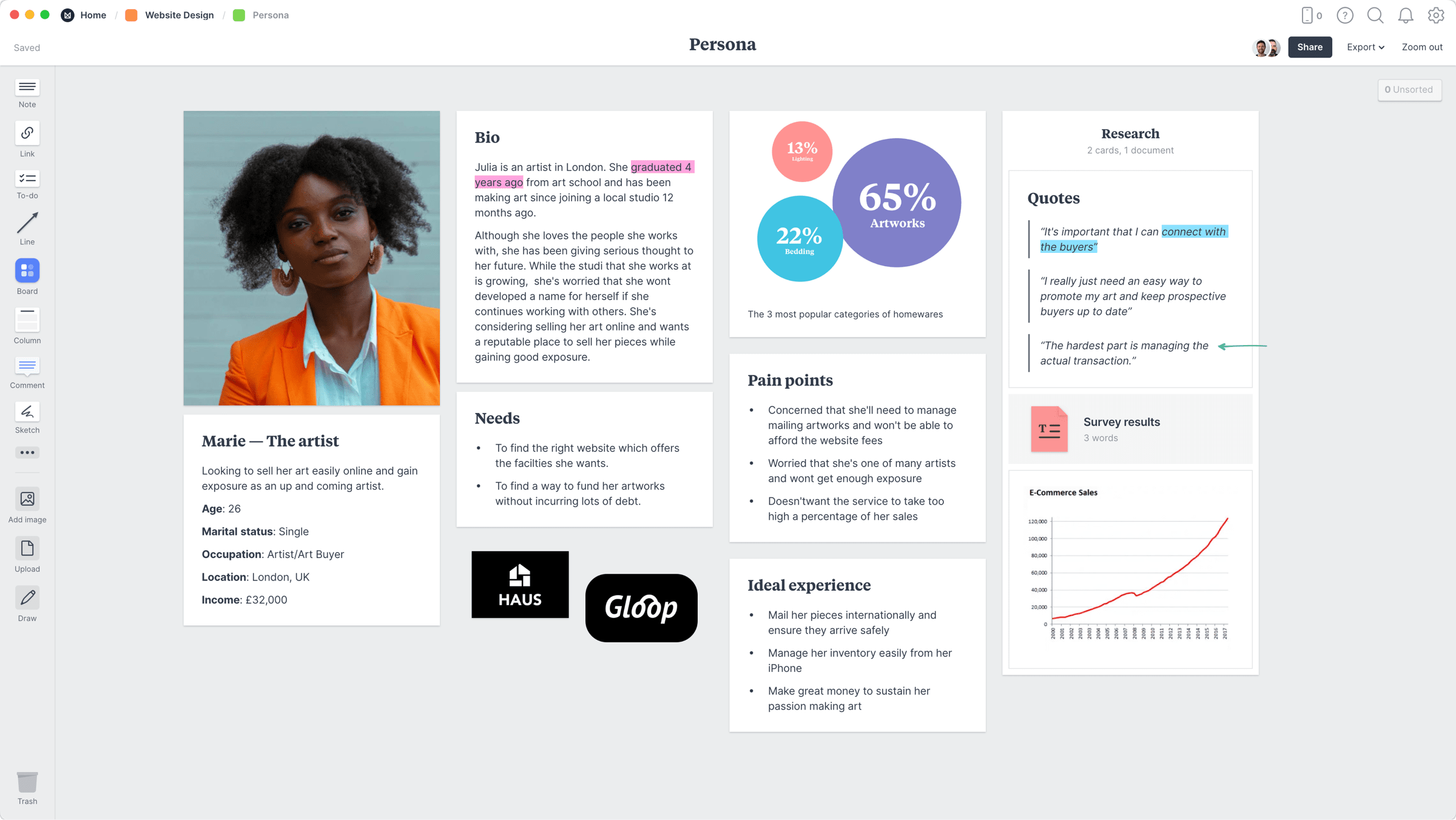
A completed design persona might look something like this.
In this example, you can find many of the common elements of a good persona. Specifically:
An identity and a name of the target user. These elements help personalize the persona and make it more than just words on a page. They help us envision the user as a real person.
Some demographics of the target user group.
A brief narrative that tells us who this person is, what they care about, and what they do. This also helps to make the persona relatable to team members.
Some representative quotes (from the user research) and brands they might care about and use.
A list of pain points or frustrations. Things that will make the persona's life better if only the team can address them.
A picture of the ideal experience. This also can be sometimes expressed in terms of the user's goals and motivations.
Note that personas are different than roles. A user role is associated with the tasks that a single user might perform relative to the system. Complex systems often support multiple roles. Examples of user roles might be System Admins and Developers. Within each role there will be one or more personas. For example, you might decide that developers should be segmented into multiple groups based on experience or other characteristics. Each of these groups might be represented by a different persona. For large complex applications with many users, it's not unusual to have multiple personas. However, it's always wise to designate a primary persona for whom design decisions will be optimized.
Why use personas?
The primary importance of personas lies in their ability to humanize the target audience, allowing teams to communicate customer needs efficiently and effectively. They shift the focus from "us" (the business) to "them" (the user).
Key benefits:
Empathy and focus: Personas help designers "step out of themselves" to recognize that different people have different needs, making design tasks less complex and guiding ideation.
Standardization: They create a consistent language and foundation for teams to align on market problems and use cases.
Alignment: They enable everyone on the team to have a common understanding of user pain points and motivations.
When to create a persona
Personas should be utilized when a team needs to align on who they are building for and how to communicate with them. Generally, personas should be created at the start of a project, but after initial exploratory research has been completed. If raw research data already exists, you may be able to streamline the process by utilizing that data as a starting point. However you choose to approach this, you should always create your persona based on actual research about users and not merely assumptions about who the users are. This will give your persona better credibility with the product team and ultimately function as a more useful vehicle for driving design decisions.
How to create a user persona
Creating personas is a structured process involving research, synthesis, and socialization. Below are the instructions for using this method, incorporating internal Red Hat methodologies.
1. Data collection and hypothesis
Begin by collecting knowledge about the users to form a hypothesis. This involves high-quality user research. Conduct interviews to understand education, lifestyle, interests, goals, and behavioral patterns of target users. Determine what roles users might play in interacting with your application. Typically you will want at least one persona per role, although in some cases a role might have multiple personas to describe different segments of users. In such cases, it will be useful to designate a primary persona around which to prioritize design decisions.
2. Analysis and segmentation
Once you have reviewed your research data, you can identify user segments by synthesizing your findings into clusters based on shared behaviors, goals, roles, and attitudes. This process moves beyond simple demographics to find patterns in how and why users interact with your product. Here are specific ways to identify and define these segments:
Identifying behavioral patterns and affinities
The most common method for segmentation in UX is finding clusters of users who behave in similar ways. Use tools like Affinity Diagrams or Empathy Maps to visualize your data and then group participants together who share similar pain points, workflows, or mental models. Once done, compare your findings against your initial hypothesis. You may find that users you thought were different actually behave the same way, or that a single group you imagined is actually two distinct segments with different needs.
Segments can be identified by plotting users on sliding scales regarding their personality and attitudes. For example, you might characterize the persona's attitude toward technology as a set of behavioral variables. A prior Red Hat persona study identified segments by rating them on specific scales, such as "Openness to change" (Resistant vs. Open), "Approach to new technologies" (Pioneer vs. Follower), and “Preference for building versus buying."You also may decide to differentiate users based on their technical proficiency or familiarity with the domain.
Segmenting by goals and motivations
You can distinguish segments by looking at what the user wants to achieve (Goal-Directed Personas) rather than just who they are. Identify what drives the user. Look at how different users measure success. One segment might prioritize "cost savings" (Procurement), while another prioritizes "on-time delivery" (IT Operations).
3. Drafting the Persona Profile
Create one page descriptions for each persona. Effective profiles should include specific sections to make them actionable:
• Challenges the persona faces: What prevents them from succeeding? (e.g., Financial concerns, lack of talent, or security issues).
• Watering holes: Where do they get their information? (e.g., Conferences, white papers, or peers).
• Psychographics: Include scales regarding their "Openness to change," "Approach to new technologies," and “Preference for building versus buying”.
• Socialization and scenarios: Develop specific situations or stories where the persona uses the product to solve a problem.
Persona examples
Example 1
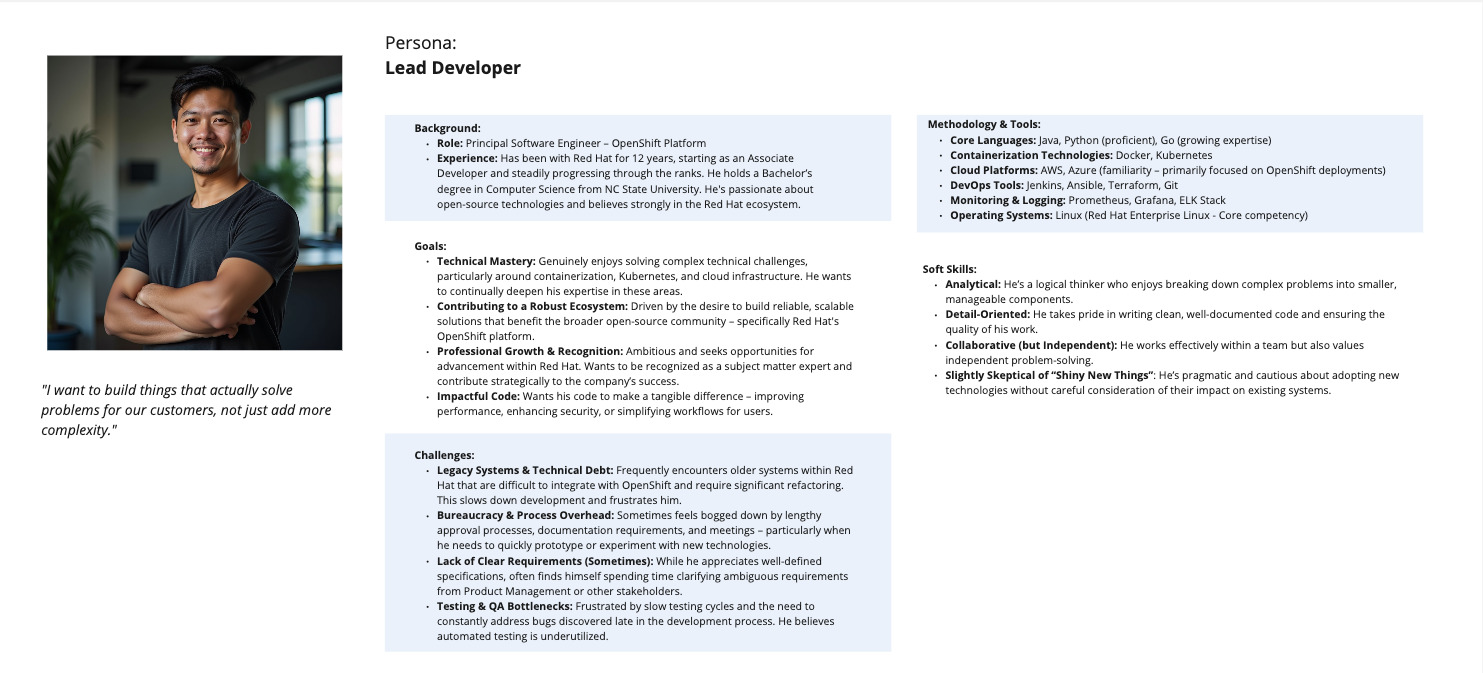
The following persona for a Lead Developer has been used by project teams at Red Hat.
Example 2
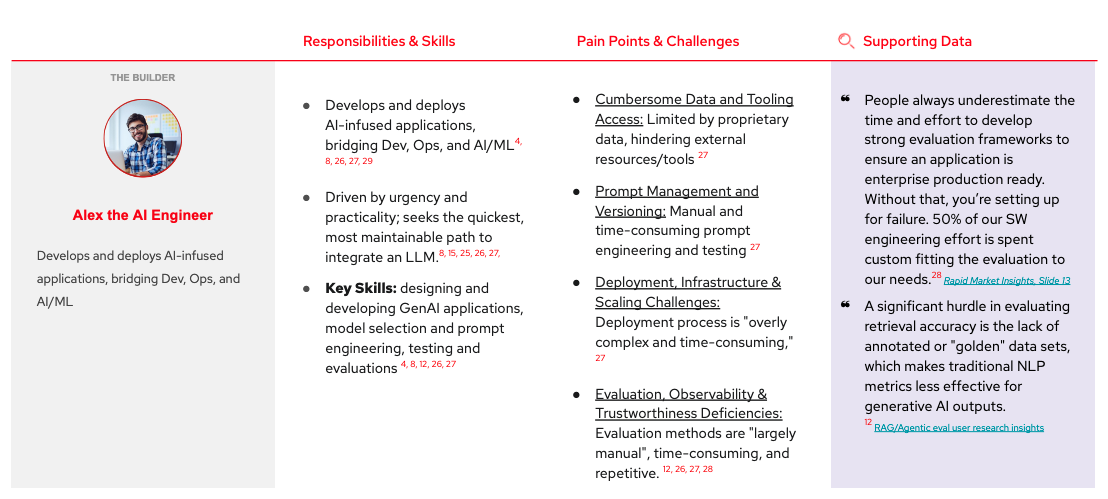
Another persona used in Red Hat project work. Note the references to actual user research insights throughout.
Example 3
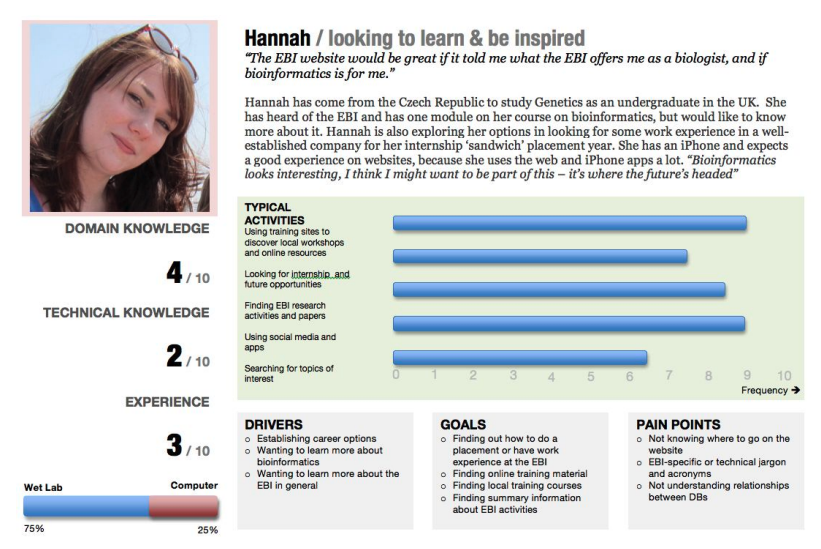
This example from the public domain uses numerical scales to make it easy to see frequency of activities and skills/experience at a glance.
Learn more
Take a look at the following articles to learn more about how to create and apply personas.
Spotted a typo? Any feedback you want to share? Do you want to collaborate? Get in touch with the UXD Methods working group using one of the links below!